


ArtWalk Artists Talk
"art is work / work is art"
Friday, October 23
5:00pm - 7:00pm
Downtown
Garmany HallJoin us for an evening with current ArtWalk artists before their show closes on October 31.
Please join us on Friday, October 23.
Reception: 5:00-6:00 p.m. light refreshments will be served
Artists talk: 6:00 - 7:00 p.m.
The reception will be held on the ArtWalk from 5:00-7:00 p.m., with light refreshments. Then we will move down to the main floor for the artist talk in Garmany Hall from 6:00-7:00 p.m.
Featuring: Allen Phillips, Chris Allen Cox, Christopher M. Schroeder, Joe Bun Keo, Jon Eastman
Group statement:
"when you walk into a gallery, an exhibition space, or the halls of a museum, you are witness to a spectrum of art. sculptures, photographs, prints, drawings, paintings, immersive audio visual installations; all of this is physically manifested by the hard work of museum laborers, whom are often overlooked, underpaid, and exploited. the hanging hardware, lighting, spacing, the intricate arrangements of casework, vinyl lettering, signage, combine to create an experience for visitors. art is work (a lot of work), and work is art, now value it like so, and pay more than respect and attention. it’s the labor of love, not the love of labor. come see the individual artistic practices of those who were creating experiences before punching the clock at your arts spaces."
Artists statements:
Chris Allen Cox: "My father is a fisherman. When I was a child, he would practice casting fishing lures on top of a hill near our house. His casts would launch a lure 40-50 feet down the grassy hillside, and I would run down to grab the lure and pretend to be a fish that he then had to reel in.
My practice is an attempt to recreate the same act. I work towards being enticed by a concept and follow through with chasing the concept until I make a visual representation that connects me to it."
Christopher M. Schroeder: "The Architecture of Identity
My work explores the intersection of microscopic code and macroscopic form, investigating how the blueprint of life manifests within the physical structures of the human body. Working at the intersection of mixed media and sculptural painting, I use acrylic gloss gel medium to build luminous, translucent layers that mimic the complexity of biological tissues.
By encasing abstracted/photo transferred representations of chromosomes, cellular pathways, and anatomical fragments within high-gloss strata, I aim to freeze the fluid boundary between internal genetics and external form. The gel medium acts as both a metaphor and a structural tool; its glass-like clarity traps light and color, creating a three-dimensional depth that invites the viewer to look beneath the surface. Ultimately, my pieces serve a visual meditation on vulnerability, inheritance, and the intricate architecture that make us human."
Jon Eastman: " The works I am exhibiting here are wood constructions he refers to as the Ply/Would: Noir series.
Begun in 2017, these monochromatic wall relief sculptures are studies employing elements of Modernism, mid-century design and architecture (esp. Brutalism, Constructivism and Art Deco.
The stark pallet of white on black allows the forms to emerge or float with high contrast and emphasis on shape, outline and movement."
Joe Bun Keo: "Bun Keo's work investigates post-Khmer Rouge intergenerational trauma, post-emo diasporic identity, post-memory, and post-scarcity materiality (neomaterialism) through sculpture, installation, found objects, and post-studio strategies. Working within an expanded sculptural field, he examines how objects function as emotional and historical vessels shaped by systems of labor, consumption, displacement, and survival.
He explores the relationship between object-oriented ontology (OOO) and recollection: how everyday objects accumulate sentimental, cultural, psychological, and political residue over time. Through acts of uprooting, recontextualization, modification, and arrangement, he attempts to access the emotional infrastructure embedded within commodities. Existent objects, re-formed structures, and fragments become placeholders for experiences that are difficult to articulate through language alone.
His practice is informed by his experiences as a first-generation Khmer American artist and the child of Cambodian refugees and Khmer Rouge genocide survivors raised in the privileged, predominantly white environment of a blue collar New England suburb. Questions surrounding heritage, ethnic fragmentation, assimilation, grief, labor, and belonging shape his relationship to objects and space. He treats materials as witnesses that carry traces of autoethnographic data, acting as time capsules.
Rather than producing entirely new objects, he frequently works with materials already circulating within contemporary society. This approach reflects an interest in excess, consumption, and the afterlives of objects within late-stage capitalism. He positions re-use not only as an aesthetic strategy, but as a conceptual and ethical response to the emotional and environmental weight of hoarding.
Installation plays a central role in his work, transforming exhibition spaces into psychological environments where objects communicate with one another and the viewer. Through proximity, fracturing, repetition, and subtle intervention, ordinary items shift from passivity into carriers of intimacy, tension, vulnerability, and irresolution.
Balancing between visibility and concealment, humor and melancholy, familiarity and estrangement, Bun Keo explores how personal narratives intersect with broader socioeconomic historical systems. Ultimately, he views objects as extensions of the human experience—enduring repositories of memory that continue to speak long after their original contexts have faded."
Downtown
| Mon, Sep 28 | 9:30AM to 6:00PM |
| Tue, Sep 29 | 9:30AM to 6:00PM |
| Wed, Sep 30 | 9:30AM to 6:00PM |
| Thu, Oct 01 | 9:30AM to 6:00PM |
| Fri, Oct 02 | 9:30AM to 5:00PM |
| Sat, Oct 03 | 9:00AM to 5:00PM |
| Sun, Oct 04 | Closed |
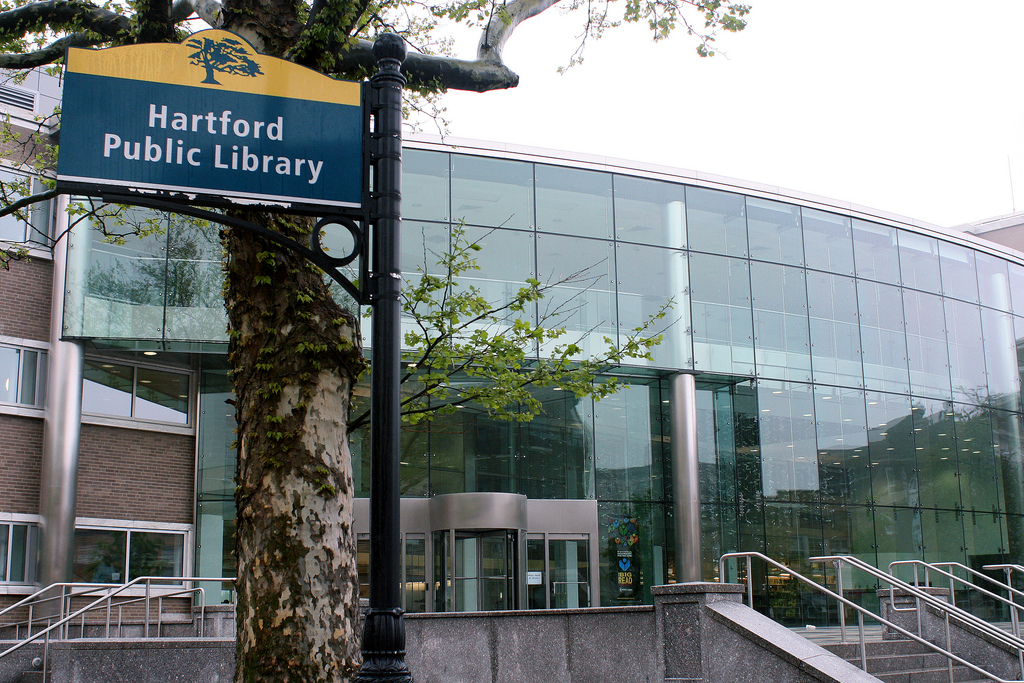
Hartford Public Library’s history spans more than 235 years. We can trace its very beginnings to the Library Company, formally organized in 1774 by a few subscribers to purchase a "collection of useful and religious books". And now, the library is a national leader in redefining the urban public library in the 21st century as an innovative and stimulating place where people can learn and discover, explore their passions, and find a rich array of resources that contribute to a full life.